Field notes
Founding Story
How a map on a garage wall, a leopard, and a Hadeda became a birding app built on Monday evenings.
Robert Elliott25 September 202614 min read
My father was not a man who kept diaries. He kept maps.
On the wall of his garage hung an enormous map of Southern Africa, and after every trip he would plot our route in a different colour and pattern, so that over the years the map became something closer to autobiography than cartography: written in roads and rivers and coastlines. The Skeleton Coast in one colour. The White Sands peninsula in Mozambique in another. Each line a story. Each crossing a memory made permanent.
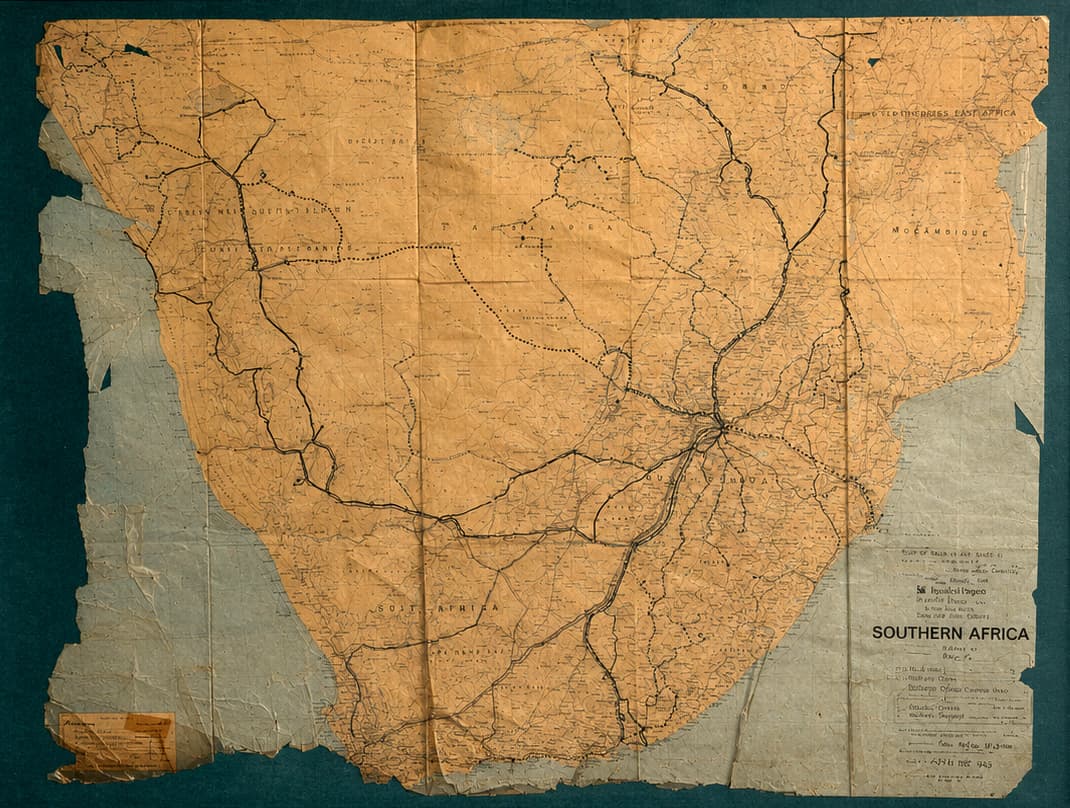
I grew up inside those lines.
Almost every holiday, most long weekends, found our family somewhere out in Southern Africa, far enough from the city that the dark was genuinely dark and the silence was full of things: nightjars, frogs, insects, unseen movement in the bush, and the pleasing unease that something out there knew exactly where you were, even if you had no idea where it was.
⸻
In 2007 I was living in London, in my mid-twenties, which is the age at which you first begin to suspect that memory is not the reliable archive you assumed it to be. I started a list. A digital list, running through the years: countries visited, concerts attended, restaurants worth remembering, holidays that had meant something.
Nostalgia had nothing to do with it. I was curating.
I had come to believe that memories need tending: that they are not stored so much as crafted, and that if you do not make something deliberate of your experiences, they soften and blur and eventually become simply a feeling rather than a fact.
⸻
A few years later, on a trip back to South Africa, I was at Ingwelala when a leopard came out of the dappled shadow at the edge of the treeline. It moved the way leopards do, barely visible, unhurried, entirely certain of its place in the order of things.
I logged it on my list.
And then I sat there wondering: where else had I seen leopards?
I had been watching wildlife my whole life. I had had sightings that deserved better than to dissolve into a general impression of "good trips". But I could not piece them together. The list I had built in London was wide but flat. It could remember places, but not encounters. It could not answer the question the leopard had left behind.
That question, it turned out, was Bindo.
⸻
Though I did not know it yet.
In 2015, my friend Simon Haw and I were working on the Custodians Trust, exploring funding models for conservation projects across Africa. Simon had co-founded SOLA Group, a renewable energy company already on its way to becoming one of South Africa's largest independent power producers. He is someone who builds things to make the world better, and is determined to see that they do. The question we kept returning to was simple, and therefore difficult: how do you engage a broad audience, and particularly the next generation, in the actual work of protecting wilderness and wildlife?
Not through the comfortable distance of a donation. Not as spectators, and not as customers of somebody else's conservation. But through something personal. Something active.
In one of those conversations I mentioned the app I had always wanted to build. Something where you could log your encounters with the natural world, your sightings and experiences, and look back through them on a map: the way my father had done on paper for decades, but now digital.
Simon and I began sketching an idea for something social and energetic that might pull younger people outdoors. But the more we talked, the more a particular group kept presenting itself as the obvious place to start: birders.
Birders are, as a community, already obsessive listers. It is not a habit they need to be taught. They are already standing in reed beds at dawn writing things down on pieces of paper that will later be misplaced, or carried in a breast pocket until they disintegrate. They are numerous and passionate.
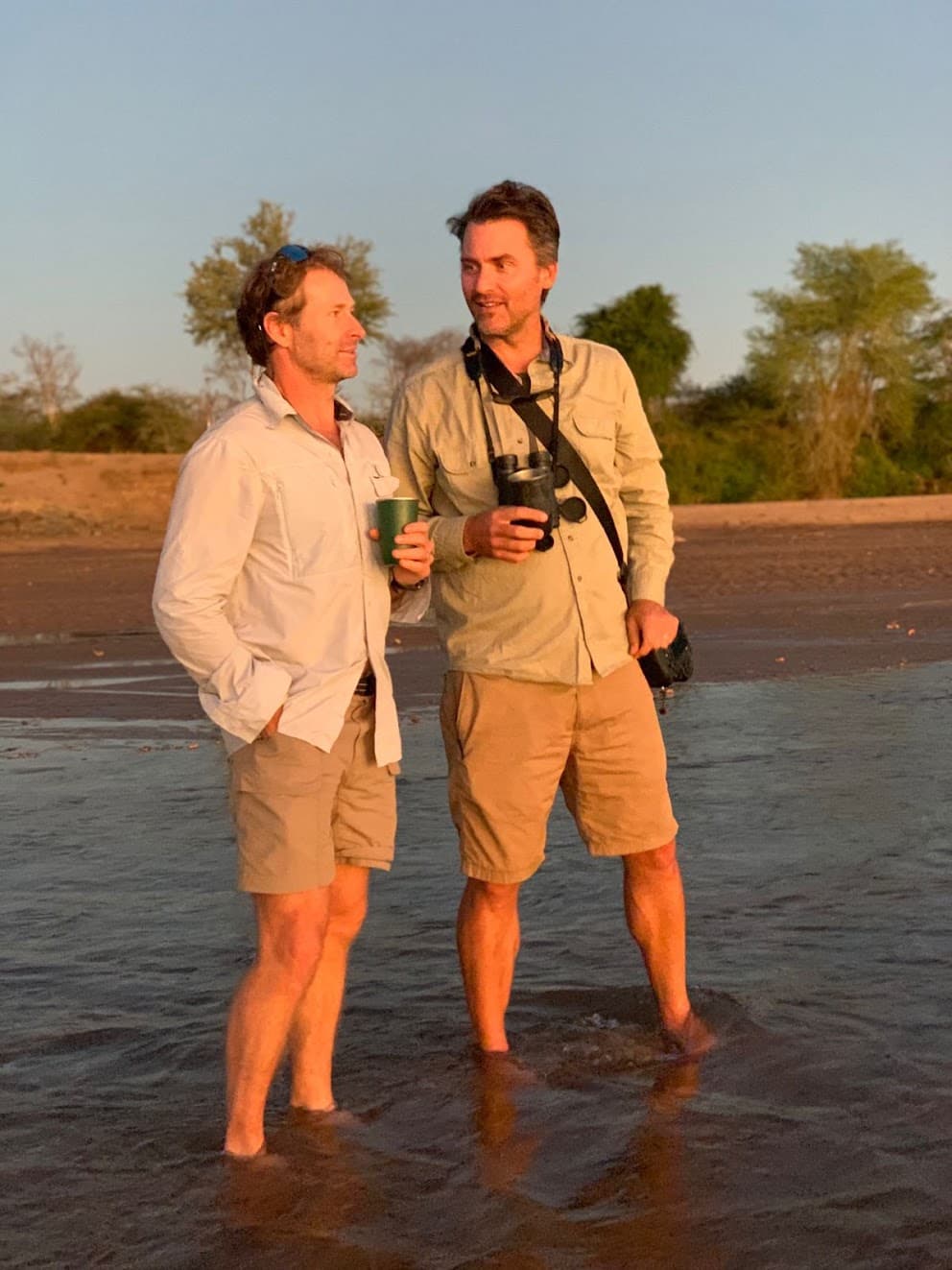
We did our homework. We met with BirdLife, with illustrators, with authors, with other app builders, with investors and technologists. The more we listened, the clearer it became. The birders were already there, binoculars up, pencils ready, waiting for someone to build the thing properly.
⸻
Progress was slow.
Simon and I both had young children and full-time lives, which is a polite way of saying that most ambitious ideas spent long periods being discussed with great conviction and then quietly postponed. Then Covid arrived and compressed everything into the same four walls. When the world began to open up again, I made the decision to commit: Simon and I would both come in as founding investors, and I would go all in as Founder and build Bindo from the ground up.
I knew from the start who I wanted shaping the look, feel and voice of it.
Nic Grobler and I had worked together at a fintech company called Kin, but what tells you more about Nic is his photography. Bicycle Portraits, ten thousand kilometres across South Africa documenting everyday people and their bikes, and Hemelliggaam, Cape communities and their relationship with the sky above them. Always alive to the wonder of the country and the people who call its most beautiful corners home.
Nic has an artist's eye and an insistence on clarity and usability, which matters when the same app needs to work equally well for a newer birder and a veteran lister. He came on board to steer the design and brand of what we were then calling Bundu.
I also knew what I did not know.
I had always birded with pleasure but without particular discipline, and we did not know the community from the inside. For that we needed Dave Winter.
Dave had been keeping meticulous field records long before any app existed to do the work for him. Decades of sightings logged by hand, each one placed and dated with the care of someone who understood that the data is important, not just the experience. As a contributor and verifier on SABAP2, the Southern African Bird Atlas Project, he knew the science and the community as well as anyone. He also worked in fintech and had a pragmatist's understanding of how products earn trust.
Dave came aboard alongside Nic, both part-time, both committed.
A young developer named Phil van Biljon joined us in October 2020, and we would spend the next three years quietly building much of what Bindo became.
From the start, the core team settled into the rhythm that would define how the app was built: Monday evenings together, working through the week's progress, feedback and problems. Nic, Dave, Phil and I around a coffee table, making the decisions that would shape the product one session at a time.
There was no grand war room. No glass boardroom. Just laptops, coffee, bird names, bugs, and the quiet belief that if we kept solving the right problems in the right order, something useful might emerge.
⸻
The first sighting ever logged on Bundu was a Hadeda Ibis. December 27th, 2020.
There is something honest about that.
Not a Pel's Fishing Owl. Not a Pitta. A Hadeda: South Africa's most democratically distributed bird, the one responsible for waking most of the country's suburbs every morning whether they asked to be woken or not.
A small group of fewer than ten people began testing the skeleton of the app. It had no images, barely-there maps, and could only log sightings when connected to the internet. That last detail would come back to matter.
But it worked. Just enough. And in early products, "just enough" can be a dangerous and wonderful thing.
⸻
By May 2021, we had changed the name from Bundu to Bindo.
There were a few reasons. The App Store turned out to be surprisingly well-stocked with things already called Bundu. The word itself, with its roots in old Zimbabwe, carried connotations that gave us pause. And while Bundu meant something to anyone who had grown up in Southern Africa, it meant very little to anyone who had not.
Shuffling vowels in and out of the name, we found Bindo. It turned out to carry its own quiet logic: "bin" from binoculars, and "do" as action, as verb, as instruction.
That June we ran our first challenge. Deren Coetzer won it with 164 birds. The community logged 2,169 sightings in a single month. For a product that had existed in test for less than six months, it was a number that told us something worth knowing.
There were people out there who wanted this.
⸻
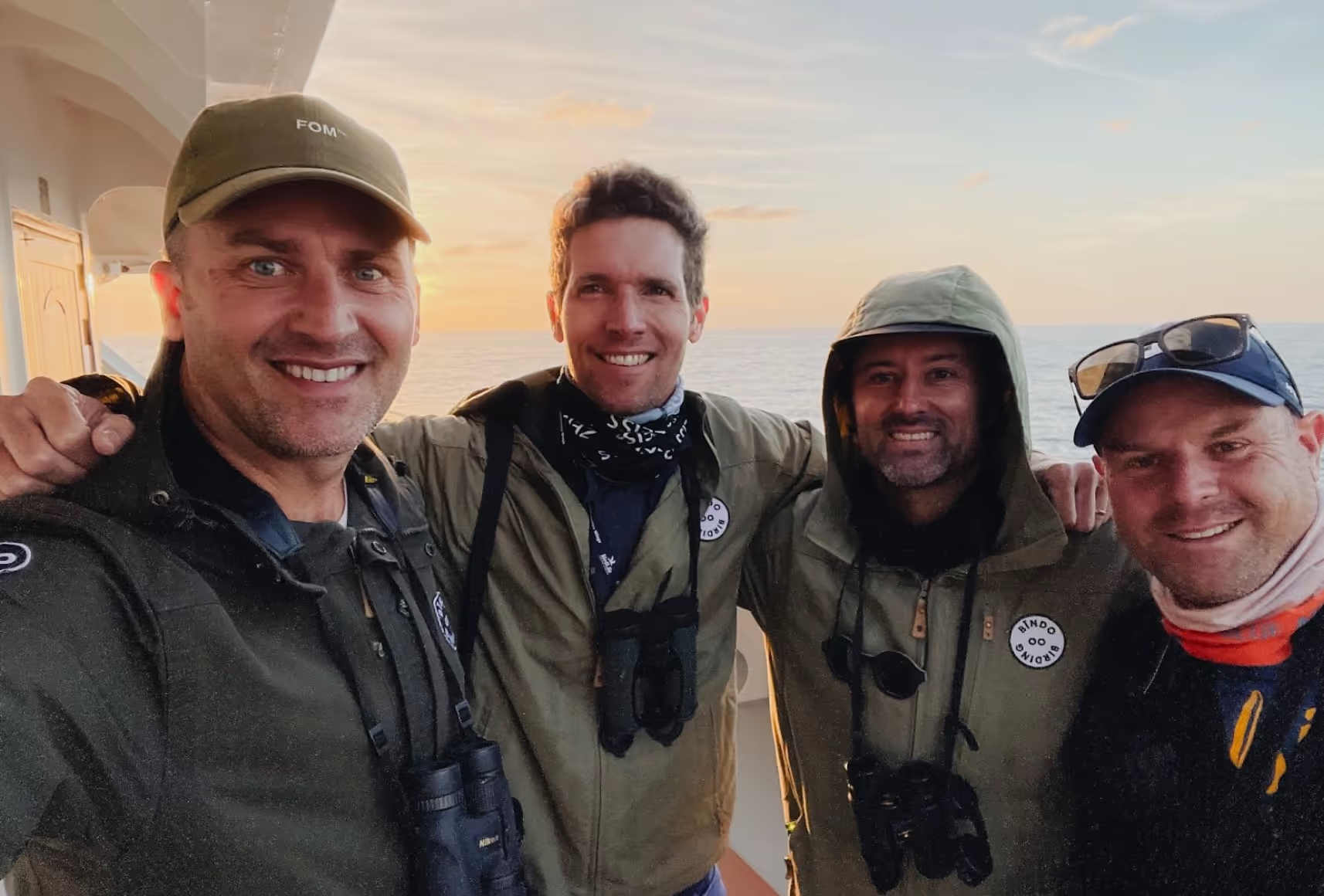
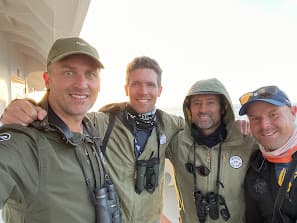
In January 2022, Dave, Nic and I joined BirdLife South Africa on a seven-day voyage to Marion Island.
It is one of the more extraordinary places on Earth: a sub-Antarctic volcanic island roughly halfway between South Africa and Antarctica, home to vast colonies of seabirds that wheel and bank above the grey ocean, crossing enormous distances at speed, seldom beating a wing, taking their power from the wind that runs over the swell. Almost nothing else lives there. The island is remote, severe, alive, and uninterested in human convenience.
We went partly to put Bindo in front of the best birders and conservation organisations in South Africa. Partly, if we are honest, because it was Marion Island.
We spent much of the voyage with Mike Buckham, a great mate of Dave's. Mike had been doing this long before smartphones existed to help: GPS units, audio recorders, handwritten field notes kept with the precision of someone who treats every outing as evidence. He knew the existing tools, exactly where they fell short in the field, and how the birding community actually operates: the shared sightings, the camaraderie, the quiet rivalry.
Mike competes hard and photographs beautifully. In the months that followed, he became one of our most valuable contributors, a birder with an unerring instinct for exactly what the app was getting wrong.
The voyage also laid bare Bindo's most significant weakness.
Out there, with no connectivity and the Southern Ocean throwing its weight around, the app worked offline. Barely. The ship's occasional WiFi signal, available on the seventh deck when conditions permitted, turned out to be almost worse than nothing: just strong enough to confuse the app into thinking it had a connection, and far too weak to honour the promise.
For a birding app built for Southern Africa, where the birds are often precisely where the signal is not, that was a flaw scaled to the country itself.
We came back knowing two things: we were onto something real, and we had to rebuild the core of it.
⸻
In February 2022, we began work on the Beta, built offline-first this time.
We had learned a great deal from our own usage, from the data, and from the birders generous enough to tell us where we had got things wrong. The Beta rethought the fundamentals: the data models, the schema, the design, the way a sighting moved from moment to memory to map.
Running alongside that technical work was a commitment we cared about just as much.
Bindo had always been conceived in the spirit of the Custodians Trust, as something that served conservation as well as the individual birder. The app had to be delightful for the person using it, but it also had to matter beyond the screen.
Integrating SABAP2 meant that sightings logged on Bindo could contribute directly to one of the most important citizen science datasets on the continent. It was not a feature. It was the point.
The first atlas cards were submitted in June 2022. There are now close to five thousand.
⸻
In May 2023, Mike joined the team properly. He had been indispensable for more than a year already. He took his seat at the Monday evenings too, completing the group that still meets today.
The app launched publicly shortly after.
The year that followed was less glamorous than a founding story might suggest. It was Monday evenings around a table, working through the week's feedback. It was birders in the field sending notes about what was broken, what was right, and what was missing. It was the slow accumulation of small improvements, each one shaped by someone who had actually been out there using the thing.
By the time we launched our first Spring Challenge in September 2024, we had around 900 users. Steady growth, earned one birder at a time.
Then something shifted.
The Spring Challenge ran for three months, with a pair of Swarovski binoculars as the prize. Guy Balme won it with 600 birds. Six hundred species in ninety days is not casual birding. It takes planning, stamina, and a working knowledge of where Southern Africa keeps its more elusive residents.
The birding community, it turned out, responds well to competition, beautiful glass, and the feeling that someone has finally built something specifically for them.
New signups in that quarter alone nearly matched everything that had come before.
⸻
Not everything went smoothly.
Early 2025 brought news that our backend hosting platform was being discontinued. Not gradually. Not with generous notice. The infrastructure on which Bindo's entire sync architecture depended would, within a year, simply cease to exist. We had to rebuild again, from the ground up.
Those months were hard going. Time and energy poured into reconstructing what already worked instead of building what the community was waiting for. Nothing about it was visible from the outside, and all of it was carried by the same few people who had been carrying everything else. In the middle of it all, in November 2025, somewhere out in the field, the one-millionth sighting was logged on Bindo.
On the darker days of the rebuild, that number and the kind words of our community kept me going.
The migration completed in March 2026, cleanly and without incident. To the outside world, nothing appeared to have changed at all. Which, for that kind of work, is the highest compliment.
⸻
Those Monday evenings continue, usually for a few hours.
The agenda is loose: birding, the app, feedback from users, things that are broken, things that are working, ideas that will probably never happen and occasionally one that will. It is where most of the week's work is shaped. It is also where much of the camaraderie lives.
Over time, the group has become one of the quiet joys of Bindo: a small committee of enthusiasts, sceptics, builders and birders, each bringing a different kind of attention to the same questions. How do you make it easier and more rewarding for people to record the natural world around them? And the larger one behind it: how do you get more people outside and paying attention to nature in the first place?
It is a small table, and it has been small for a long time.
A bird seen and not recorded is not wasted. Of course not. The world does not require our notation to be real. But a sighting recorded becomes something more durable. It joins a personal history. In the right circumstances, it contributes to a scientific one. It can be found again. It can be shared. It becomes part of the story a person tells about their life outdoors.
⸻
Bindo is not a startup that looked at birds and saw an interesting vertical.
It is something older than that.
It is my father's map, made digital and made communal. It is the leopard at Ingwelala and the question it asked that nothing else could answer. It is the conviction that the encounters we have with the natural world are worth recording and worth keeping.
I was fortunate. I had parents who drove me into the wild and kept a record of it. I still go on trips with my mum. Not everyone has that.
Bindo is an attempt to give it to anyone who wants it.
A way to draw your own lines across the map. A way to keep the wild places in your life from becoming only a feeling.
⸻
That is the story so far. It has been written by a handful of people around a coffee table, and by every birder who took the trouble to tell us what we had got wrong.